
This Week in Robotic Learning (TWIRL) #6: There are no robotics companies
Only research labs with a dream

The robotics content #RoboticsContent that got the most traction this week was this essay from DYNA co-founder York Yang. In it, he argues that the investments in current robotics companies (not his!) assume a speed to deployment that is out of line with their valuations.
The key section:
So the right question isn’t “is robotics overhyped?” The right question is:
Can current robotics capability produce commercially meaningful value in a reasonable time, and is that value linearly tied to underlying technical progress?
If yes, it isn’t a bubble. If no, it is.
By that measure, large parts of the current robotics market are bubbles — not because the technology won’t get there, but because the timeline between current capability and meaningful commercial value is longer than current funding levels assume.
Bubbles, you say?
This is somewhere between “certainly right in literally all current robotics cases” and “certainly right in the majority of robotics cases.”
He goes on to argue that the pathway for robotics is: doing something useful -> gathering data while being useful -> improving the model and hardware via that useful data.
That’s very clearly a viable approach. It’s a somewhat consensus view that data collection is the bottleneck on progress, and an approach where a company can collect useful data and extend its runway makes a ton of sense. In fact, it may well prove to be the only pathway.
But I do want to speak up in defense of the “let’s go do a bunch of research and hope it works out” approach.
How to avoid fading into Bolivian
Tech and business people love the Mike Tyson quotation, which over time has been popularized as “Everybody has a plan until they get punched in the mouth.” It’s a call to be agentic. To take action. To seize the day. To punch someone in the mouth.
But also… have a plan? A couple years after he said (something like) that, Mike Tyson went to Tokyo, spent the pre-fight period partying with Bobby Brown and, uh, enjoying himself, and got beaten by Buster Douglas, a vastly inferior opponent. Planning and preparation do actually help.
Part of what I find so compelling about robotics at this moment in time is that it really is an open-ended intellectual problem. Is the right approach plugging away in a research lab? How can we scale up high quality, usable data? What hardware advances need to be made to get to mass deployment? Do software and hardware need to be integrated or can they be developed separately? What’s the right form factor, and when? How will these machines reshape our world?
The answers to the above questions are basically unknown. There are a lot of unknowns that need to be answered before robotics labs can prosper.
There are no VC-backed robotics companies
The thesis here, is three claims:
1. These firms aren’t companies they’re research labs, which means they, definitionally, have a runway problem.
2. At this distance from useful products, today’s leader probably does not predict tomorrow’s winner.
3. Therefore openness with research and other information is rational.
Let’s make that case!
There is real time pressure on this set of general purpose robotic intelligence research labs. Their products are not market-ready. One way to get there is through deployment. But the “pure research” pathway exists too. And with that time pressure, these firms need to do everything they can to accelerate the pace. So I’m deeply frustrated by the opacity with which some of them operate and view it as a missed opportunity.
DYNA, Physical Intelligence, Skild, Figure, 1x, Sunday, Generalist and on are not companies in the way that, say, Walmart is a company. Walmart offers its goods and services to customers, who pay Walmart more money than it costs them to produce or acquire them. The difference–and this may be a technical term unfamiliar to roboticists–is often called “profit.” (We kid because we love).
These firms are VC-backed research labs who are pursuing a path toward eventually becoming a company. NVIDIA, Google, and Tesla have a robotics division that are funded out of their R&D budgets; their time pressures aren’t as urgent. The independent firms are R&D and that’s basically it. They need progress to advance rapidly.
Now, “rapidly” doesn’t mean “tomorrow.” These investments were made in research labs with the understanding that it will take some time to transition into becoming a company. But there’s a lot of work to be done to get from “we got a robot to make a grilled cheese sandwich in a lab” (which is a towering achievement, to be clear!) to “a robo-butler deep fries a turkey while folding laundry.”
Yang offers one approach to scaling up a research lab’s knowledge: get out in the world and deploy. I want to emphasize another one: tell people what you’re doing.
The open flow of information–and not just research papers about glorious successes, but also documentation of bottlenecks, what isn’t working, the business challenges, and everything else that it takes to move to the frontier of robotics can help accelerate industry-level growth and create the most winners out of the current batch of research labs.
All of which brings me to a basic question.
Why would a robotics research lab keep its research proprietary?
If you want to go fast, go alone; if you want to go far, go together
The answer, of course, is: “We know things that our competitors don’t know, and it gives us an advantage over them.”
But, again, it is not at all clear that general purpose, generally intelligent robotics is a real business! How long will these labs be able to play in their sandboxes before investors get impatient? Before they run out of money? It’s probably an acceptable outcome to become the fifth-largest player in a multi-trillion dollar industry. There is no advantage to be gained by going out of business with a slightly better performance than your competition.
To make an analogy: if you’re interviewing to become a hedge fund analyst, say, in order to impress the hiring manager you probably need to say some stocks you think are good and why. There is, of course, a risk that the person interviewing you will steal your ideas and go buy the stocks without hiring you. And when that happens, it is a bummer. But if you’re going to succeed in the role, you need more than one idea. This far away from the finish line, there may not be any correlation with today’s leader’s and tomorrow’s real winners. So we might as well figure out how to shorten the race a bit.
In this space, “general robotics totally fails” a real risk that labs should take more seriously. Physical Intelligence publishes a ton of research presumably because they think it will 1) attract researchers who want to publish / are impressed by their results, 2) accelerate development within the industry that will redound to their benefit and 3) having this information in the open will cause them less harm than the value of #1 and #2.
They’re right on all three, and presumably expect #3 to flip as they approach commercial viability or approach a significant breakthrough, similar to OpenAI’s trajectory. I guess they could, knowing this, publish a bunch of research over a period of several years, then, as a recruiting strategy, go dark and vaguely hint about world-changing breakthroughs. Seems a bit underhanded, but kind of a funny idea. But they’re the only lab with that specific option because they’ve put out so much research!
To be fair, most of these companies publish something now and again, but it’s often blog posts that are light on crucial details or product launch demo videos that are the equivalent of showing me making five three pointers in a row to demonstrate that I’m the greatest shooter of all time while ignoring the hour or so of missed jumpers that preceded a few makes.
I expect in some cases, this more of a capacity problem (no time to publish out research! Only time for more research!) than a strategic choice.
Winners in the robotics space will be determined by some combination of the quality of their future research, their choice of market to pursue, their manufacturing capacity and their approach to hardware integration.
If your bet is that manufacturing capacity is most important, then, sure, be secretive. So, to that extent, I get why Tesla’s approach (share nothing) is what it is.
But the small labs? Scale is not how they win; not yet, anyway. There’s going to be a lot of luck in determining winners and losers in this space, and I don’t pretend to know what the exact path to victory will be. Maybe they all fail! Maybe Unitree captures all the robotics value and this was a huge waste of time to try and we can have a rueful laugh about it later.
Even in the rosiest scenario, it’s almost certain that Yang’s point is right. This is a bubble and many of these smaller labs will not survive for timing reasons if nothing else. But by working solely in secret, they’ll go out not with a bang, but with a whimper.
Let’s look at some robots
The above release was, in part, the inspiration for the “it’s to your benefit to disclose everything” rant above. Genesis AI, a US/French company put out the above video, and at first, everyone was impressed. They got two hands to rock out on a piano and solve a Rubik’s cube! Not at the same time (that would be very cool), but still, this is a breakthrough achievement.
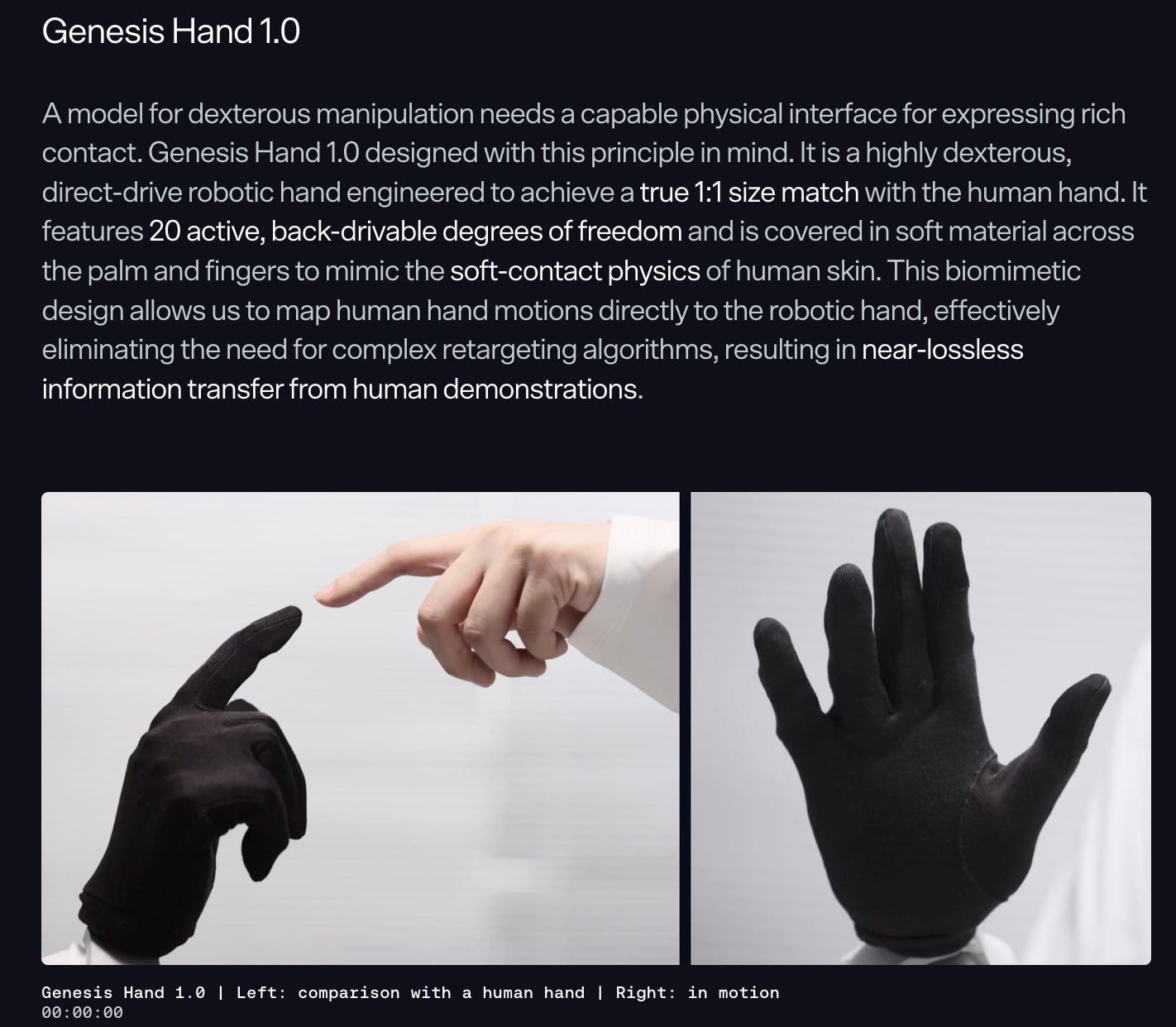
However, there was some ambiguity on the wording in their blog, where commenters felt misled (partly via omission, partly via the naming of the “Genesis Hand 1.0” and discussion of engineering, as well as that Genesis’ Twitter account refers to them as “full stack” when in fact, the hardware was from a Chinese manufacturer. The point here is that… the breakthrough still stands! Watch that video again, it’s incredible! The messaging, though, was a miss and led to some preventable backlash and lost trust.
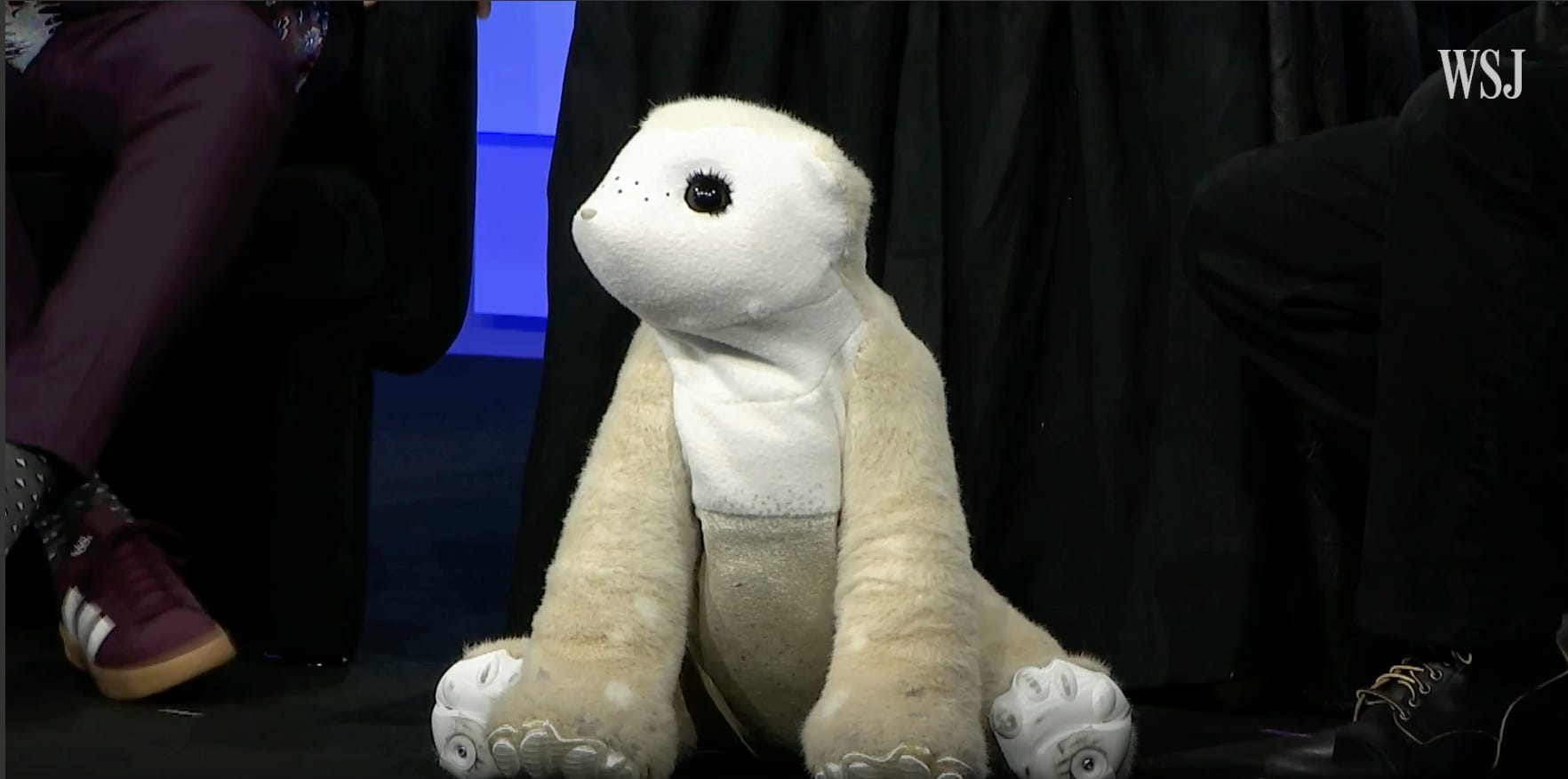
I want home robots to be pleasant. It’s a thing I’ve harped on before. Familiar Machines & Magic demoed Daphne to the Wall Street Journal, and boy, are they trying to corner the “cute and cuddly robot” market. Co-founder Colin Angle (iRobot co-founder) describes Daphne as an “abstract bear,” which is a very funny, but also accurate thing to say.
In the lineage of Paro, the therapeutic robot seal, Daphne is not meant to be useful, it (she?) is meant to be pleasant to be around–a toy.
And Daphne has a name! OpenAI has been trying to position themselves as producing AI tools, contra Anthropic which, I guess, is a cult that worships Claude and will turn over decision-making to it in a grim, dystopian way. I, uh, disagree, but think they are getting at a correct point that Claude users are more fond of Claude than ChatGPT users are of ChatGPT. There are reasons for this, but I’m pretty persuaded by the guy who argues that a lot of this is just that Claude is recognizably a name rather than an increasing series of numbers and decimals. So, Daphne.
At this point, Daphne is a technology in search of a use case, but I think it’s useful to understand what a team of Disney Imagineers and one of the most successful home roboticists ever think people will actually like to be around. Hopefully other companies in the space will be able to incorporate some of the relevant design principles to more directly productive use cases.